
How to Build a Reliable 90-Day Cash Forecast
A 90-day cash forecast that is consistently within five percent of actuals is not magic. It is methodology.

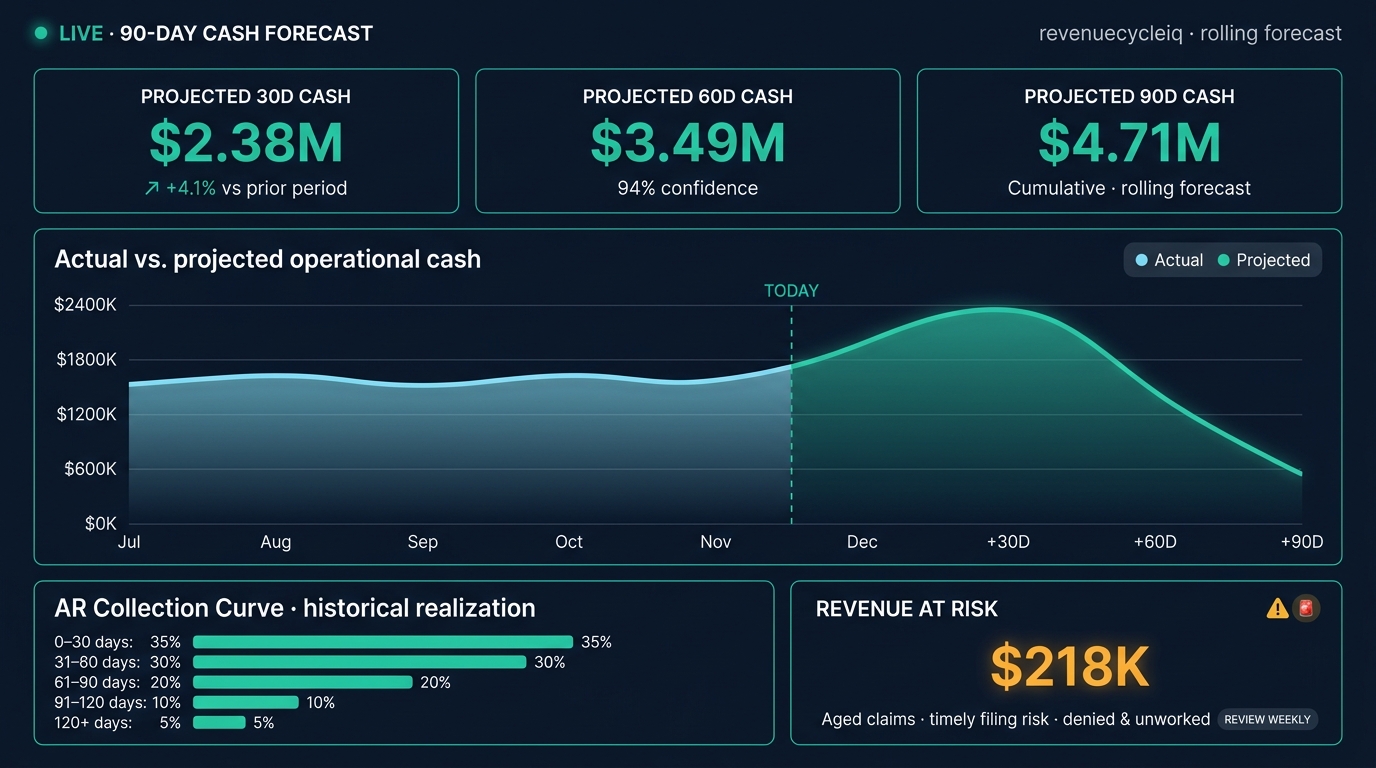
- Forecast bottom-up by payor and aging bucket, not top-down by trend.
- Track variance weekly and recalibrate factors monthly.
- The biggest forecast killer is unmodeled denial recovery timing.
For many healthcare organizations, cash forecasting feels more like guesswork than financial planning.
Finance teams often rely on historical averages, rough estimates, or payor assumptions that can quickly become inaccurate when denials increase, payment patterns shift, or operational performance changes.
The reality is that highly accurate cash forecasting is not achieved through spreadsheets alone. It is achieved through a structured methodology that combines historical payment behavior, accounts receivable analysis, payor trends, and operational performance indicators.
Organizations that consistently forecast within five percent of actual cash collections typically follow the same framework.
Why Cash Forecasting Matters
A reliable cash forecast allows leadership teams to:
- Improve financial planning
- Anticipate cash flow challenges
- Support staffing decisions
- Manage vendor payments
- Prepare for growth initiatives
- Improve lender and investor confidence
Without a reliable forecast, organizations are often reacting to financial challenges rather than proactively planning for them.
Step 1: Start With Your Current Accounts Receivable
The foundation of every cash forecast begins with existing accounts receivable.
Many organizations make the mistake of assuming all AR will eventually convert to cash. That is rarely the case.
Instead, AR should be segmented by:
- Aging bucket
- Payor
- Financial class
- Denial status
- Collectability
For example:
| AR Age | Expected Collection Rate |
|---|---|
| 0–30 Days | Very High |
| 31–60 Days | High |
| 61–90 Days | Moderate |
| 91–180 Days | Lower |
| Over 180 Days | Significantly Reduced |
The older the balance becomes, the less likely it is to convert to cash. Forecasting should account for this reality.
Step 2: Analyze Historical Payment Behavior
Not all payors reimburse at the same speed. Some consistently pay within 14 days. Others may average 45 to 60 days.
A reliable forecast incorporates actual payment patterns rather than industry assumptions.
Key questions include:
- How many days does each payor take to pay?
- What percentage of claims are paid on first submission?
- Which payors generate the highest denial rates?
- Which payors consistently delay reimbursement?
Understanding historical payment behavior creates significantly more accurate forecasting models.
Step 3: Account for Denials
One of the biggest forecasting mistakes organizations make is assuming every submitted claim will be paid.
Claims are often delayed due to:
- Authorization denials
- Eligibility issues
- Medical necessity denials
- Documentation requests
- Corrected claim requirements
If your denial rate is 12%, your forecast should reflect the expected delay associated with those claims.
Forecasts that ignore denial trends often overestimate future cash performance.
Step 4: Incorporate Operational Performance Metrics
Revenue cycle performance directly impacts cash flow. Key metrics that should influence forecasting include:
Clean Claim Rate
A lower clean claim rate typically results in delayed reimbursement.
Denial Rate
Higher denial rates reduce short-term cash collections.
Charge Lag
Delays in claim creation delay future cash realization.
Accounts Receivable Aging
Increasing balances over 90 days often indicate future collection challenges.
Forecasting models should incorporate these operational indicators rather than relying solely on financial data.
Step 5: Create Collection Curves
One of the most effective forecasting techniques involves building collection curves. Collection curves identify how cash is historically collected over time.
Example:
- 35% collected within 30 days
- 30% collected within 31–60 days
- 20% collected within 61–90 days
- 10% collected within 91–120 days
- 5% collected after 120 days
These patterns allow organizations to predict future cash collections with significantly greater accuracy.
Step 6: Identify Revenue at Risk
Not all AR should be treated equally. A strong forecast identifies accounts that may never convert to cash.
Examples include:
- High-dollar unresolved denials
- Timely filing risks
- Medical necessity denials
- Aged self-pay balances
- Underpaid claims awaiting appeal
Forecasting should separate collectible revenue from revenue at risk. This provides leadership with a more realistic financial outlook.
Step 7: Build Rolling 30-, 60-, and 90-Day Forecasts
Rather than creating a forecast once per quarter, leading organizations maintain rolling forecasts.
Each month, forecasts should be updated to reflect:
- Current AR balances
- Recent payment activity
- Denial trends
- Operational performance
- Emerging risks
A rolling forecast provides leadership with continuous visibility into future cash performance.
Common Forecasting Mistakes
Many healthcare organizations struggle with forecasting because they:
- Assume all AR will be collected
- Ignore denial trends
- Use outdated payment assumptions
- Fail to account for charge lag
- Exclude operational metrics
- Do not regularly update forecasts
These mistakes often lead to significant variances between projected and actual cash collections.
What Best-in-Class Organizations Do Differently
Organizations with highly accurate forecasts typically:
✔ Analyze AR at a detailed level
✔ Monitor payor payment patterns
✔ Incorporate denial performance
✔ Track operational KPIs
✔ Update forecasts regularly
✔ Identify revenue at risk early
✔ Use data-driven collection assumptions
Forecasting becomes significantly more accurate when it is based on operational reality rather than financial assumptions.
Executive Takeaway
A reliable 90-day cash forecast is not built from a spreadsheet alone.
It is built from a combination of accounts receivable intelligence, payor behavior, denial trends, operational performance, and disciplined forecasting methodology.
Organizations that develop this capability gain a significant strategic advantage because they can anticipate financial challenges, allocate resources more effectively, and make better business decisions.
The goal is not simply to estimate future cash collections. The goal is to create a forecasting process that leadership can trust.
Questions Every CFO Should Be Asking
- How accurate was our last forecast?
- What percentage of AR is truly collectible?
- Which payors are creating the greatest forecasting risk?
- How are denials impacting future cash flow?
- What operational issues could impact collections over the next 90 days?
The answers to these questions are often the difference between reactive financial management and proactive financial leadership.
Want Greater Visibility Into Future Cash Performance?
Revenue Cycle IQ's Revenue Forecast solution combines AR intelligence, denial trends, payor payment behavior, and operational KPIs to help healthcare organizations improve forecasting accuracy and identify revenue at risk before it impacts cash flow.
Stay Ahead of Revenue Cycle Trends
Subscribe to receive executive insights, industry trends, revenue cycle strategies, KPI guidance, denial management best practices, and AI innovations delivered directly to your inbox.
Ready to Improve Revenue Cycle Performance?
Explore Revenue Cycle IQ's consulting services, analytics solutions, and executive intelligence tools designed to help healthcare organizations improve financial outcomes.